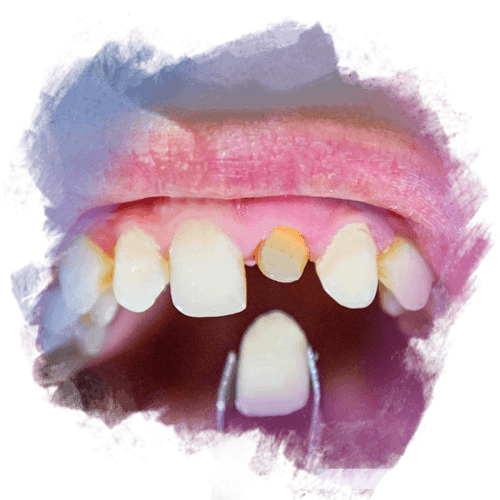
Post-Orthodontic Tissue Adaptation
After changing the position of the teeth, an adaptation process may occur in the papilla area.
Interdental Distance and Morphology
If there is no wide contact area, the papilla cannot find support in triangular-shaped teeth and appears flattened.
Aging and Tissue Thinning
Over time, collagen reduction, changes in circulation, and connective tissue weakness affect papilla shape.
Loss of bone support, trauma, improper floss use, orthodontic changes, age-related tissue weakening, tooth contour shape, and periodontal infection play a fundamental role in papilla loss.
Symptoms of Gum Papilla Loss
- Appearance of black gaps between teeth
- Food trapping
- Aesthetic discomfort, shadow effect
- Air leakage during speech, whistling sound
- Gum sensitivity
- Difficulty in cleaning and plaque retention
Papilla loss is often described by patients as “I noticed a shadow and gap when I smile.”
Treatment Methods for Gum Papilla Loss
Periodontal Support and Tissue Health
Firstly, periodontal disease is brought under control.
Professional cleaning, root surface smoothing, and tissue healing protocols are applied.
Papilla Regeneration Techniques
The papilla can be reshaped using methods such as tissue biostimulation, connective tissue grafts, and microsurgical papilla reconstruction.
Hyaluronic Acid Injection
As a minimally invasive option, hyaluronic acid can be applied to the papilla area.
It temporarily increases tissue volume, reducing the appearance of gaps.
Composite or Porcelain Restorations
Tooth shape is optimized to support the papilla.
Contour restoration is especially effective in triangular-shaped teeth.
Orthodontic Approach
If necessary, tooth positions are adjusted to restore contact areas and papilla support.
Laser Tissue Biostimulation
Supports collagen activation and accelerates tissue metabolism.
At-Home Care Steps
- Gentle brushing techniques
- Proper floss use
- Selecting the correct size of interdental brush
- Avoiding excessive mechanical pressure
However, it is not possible for the papilla to regenerate at home; at-home care only helps monitor and prevent further progression.
Single-Clinic Approach Guide
Bone Level + Tooth Shape + Tissue Biology
- Periodontal examination and radiography
- Analysis of tooth shape and contact area
- Determination of tissue thickness and biotype
- Periodontal stabilization
- Selection of papilla augmentation technique
- Orthodontic support if necessary
- Contour design with composite or porcelain
- Stepwise tissue monitoring and care protocol
This approach is based on structural support + tissue regeneration + aesthetic design.
Gum papilla loss is one of the sensitive components of interdental aesthetics and oral function. Once the papilla tissue is lost, it does not regenerate spontaneously; therefore, a combination of steps such as analyzing bone support, ensuring periodontal health, and optimizing tooth shape and contact area is required. Modern periodontal aesthetic procedures can reconstruct the papilla area using microsurgery, biostimulators, composite contour adjustments, and orthodontic support. Treatment is personalized and planned in conjunction with facial and smile aesthetics; with the correct approach, a natural papilla appearance, functional comfort, and aesthetic integrity are achieved.